
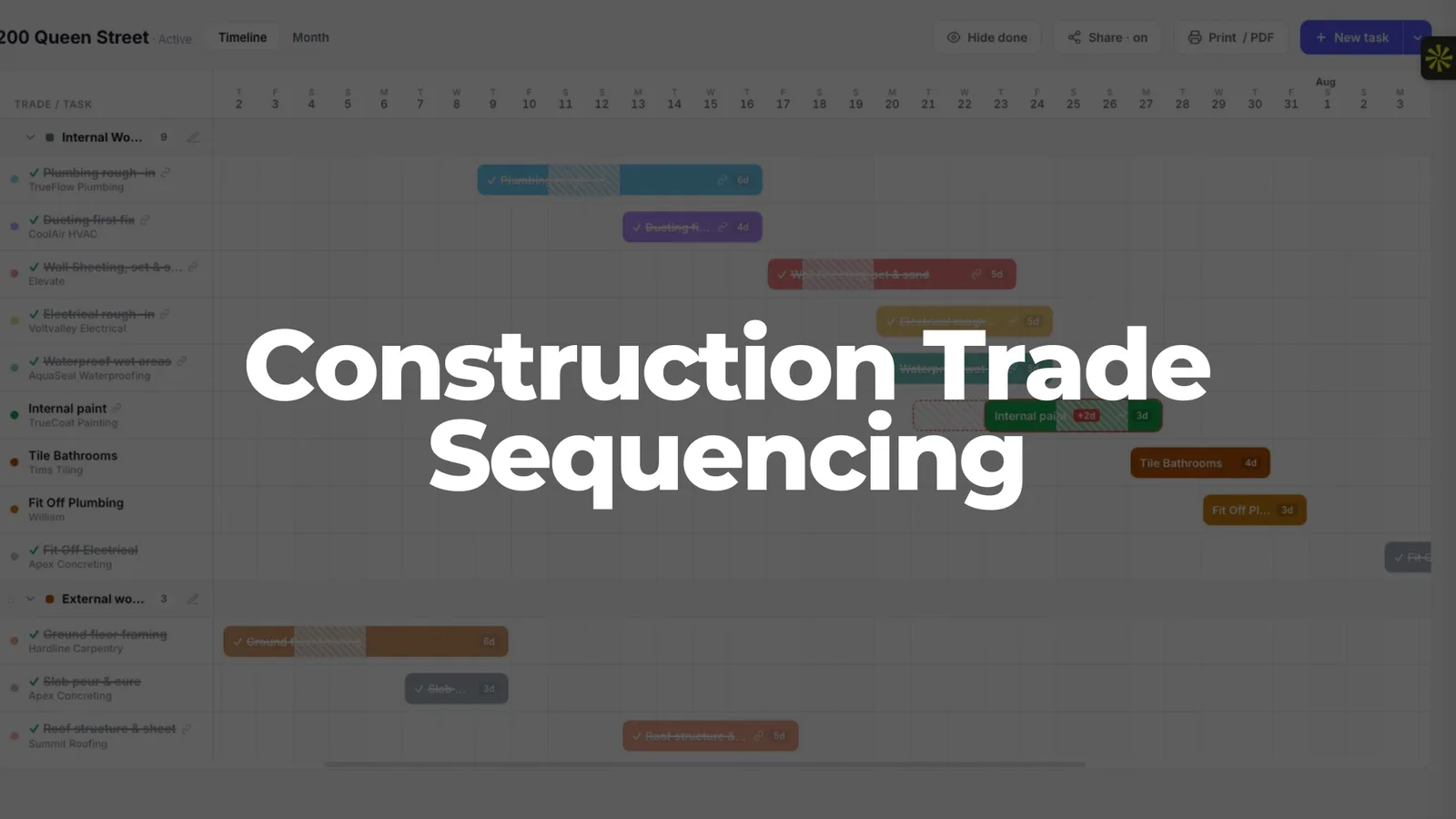
Every build — a house, a renovation, or a commercial fit-out — sends dozens of trades through the same site in a specific order. Get that order wrong and you’re looking at idle crews, blown budgets, and a handover date that keeps moving. This guide walks through construction trade sequencing for Australian builders — phase by phase — so you can plan a construction program that actually holds up on site. The worked example here is a residential house, but the same logic applies to commercial jobs: the trades and stages change, the dependencies don’t.
What is construction trade sequencing (and why it matters)?
Construction trade sequencing is the planning and scheduling of building trades in a logical order across every construction stage. It’s not just a task list pinned to the site-shed wall — it maps the dependencies between trades, defines what must be built first and what can happen at the same time, and accounts for inspections, procurement lead times and risk buffers.
Good sequencing reduces rework and protects quality by keeping the order of operations right. It minimises downtime, cuts idle labour hours, and keeps change orders manageable. Poor sequencing is a primary driver of delays and budget overruns: when one trade is late and the next three are already booked, you lose those windows — and those trades move on to other jobs.
Each trade needs to hand off a completed workspace to the next, so crews and materials should arrive only when the space is ready. That stops finished work being damaged, and it lowers the risk of accidents from trades stacking up in confined spaces.
The difference between ad-hoc trade booking and a sequenced program is visibility. With ad-hoc booking you react day to day; with a sequenced program, the builder, supervisor, subbies and client can all see the order, the dependencies and the hold points. A typical Australian house — slab-on-ground, brick veneer, single storey — runs roughly 16 to 24 weeks under normal weather, so every handover counts.
Tools like SiteCal let you visualise and adjust trade sequencing on a Gantt or calendar view instead of wrestling with brittle spreadsheets where one change breaks everything downstream.
The construction phases of a typical house
A typical Australian detached house runs through seven stages, each grouping related trades and activities. These give you the backbone for your program.
- Pre-site: design finalisation, approvals, site establishment, demolition if required, site clearance.
- Base stage (concrete slab): surveyor set-out, earthworks, under-slab plumbing, termite treatment, slab pour — the first major milestone.
- Frame stage: carpenters erect wall and roof frames, structural steel, truss delivery and fixing.
- Lockup: external doors and windows, brickwork or cladding, sarking, and roof plumbing — a weather-tight shell.
- Rough-in: electrical, plumbing, HVAC and data cabling within the closed envelope.
- Fixing and fit-off: internal linings, interior doors, waterproofing, tiling, painting, cabinetry, plumbing fixtures and electrical fit-off.
- External works and practical completion: driveways, landscaping, fencing, external painting, final inspections, defect rectification.
Sequencing happens both across stages (you can’t frame before the slab cures) and inside them (the plumber must finish under-slab drainage before the concreter pours). Commercial jobs run a different set of stages — demolition, base-build, partitions, ceilings, services, finishes, commissioning — but the principle is identical: each stage hands a finished workspace to the next. In SiteCal you can mirror whichever phases you run as grouped bands in the program, so the schedule is easy to follow for the team and your subbies.
Lock in your trade sequence early
Trade-sequencing decisions belong in pre-construction planning — before site start, not once the job’s underway. Planning defines scope, responsibilities, risks and workflow, and getting it right heads off delays from weather or materials later.
Cover these before you break ground:
- Review drawings and specifications. Walk the drawings, engineering details and specs to identify the order of trades, long-lead items (windows, trusses, cabinetry) and any overlaps. A detailed work breakdown structure (WBS) forces you to think through every task and its dependencies — the same groundwork in how to create a construction program.
- Map the critical path. The critical path tells you the minimum project duration and where you have float — so you know which trades can slip and which can’t.
- Check capacity across jobs. Running three builds in Q1 2027? Confirm your framing carpenter isn’t double-booked. A good schedule defines what, when and who — across all your jobs, not just one.
- Confirm inspection requirements. Council and certifier hold points (footing, frame, waterproofing) drive the sequence; plan around these non-negotiable checkpoints.
- Account for budget risk. Research shows 75% of projects exceed their planned budget due to changes — getting the sequence right up front reduces the scope for costly rework.
SiteCal’s multi-project dashboard shows where the same trade appears on different jobs, so clashes are spotted early rather than on a Monday-morning phone call.
Base stage: from set-out to slab
The base stage sets the foundation for everything after it. It starts with the surveyor’s set-out — staking building corners, levels and alignment. Without an accurate set-out, every downstream trade risks misalignment.
Next the earthworks contractor handles cut, fill, grading and compaction. Once the pad’s prepared, the plumber installs under-slab drainage (sanitary and stormwater), then the electrician runs any conduits needed beneath the slab. The termite specialist installs the barrier system — mandated in most Australian jurisdictions before the pour.
The dependencies here are strict:
- Under-slab drainage must be inspected and approved before the plastic membrane goes down.
- Reinforcement mesh and steel go in after the membrane and before the pour.
- Concrete curing can’t be rushed — it’s a safety-critical step.
- Booking your certifier is a task in itself; allow for inspection and approval time.
Weather matters: don’t book a slab pour into a forecast heavy-rain week, especially a Melbourne June. Coordinate concrete-truck bookings tightly to your confirmed pour date so trucks aren’t congesting site or waiting.
In SiteCal, linking tasks (“under-slab plumbing” → “termite barrier” → “reinforcement inspection” → “slab pour”) means a delay to one automatically pushes the rest — no accidental overlap, and no pour booked before the inspection clears.
Framing and the structural shell
Once the slab has cured and passed inspection, the frame stage begins and the structure takes shape.
- Frame delivery and erection. Materials arrive and carpenters erect wall frames, then floor framing if applicable. Structural steel (lintels, engineered beams) is installed during or straight after wall framing.
- Roof trusses. Trusses follow wall-frame completion. On tight-access sites, crane lifts must happen before scaffold or neighbouring structures block access.
- Roof cladding. The roofer closes the envelope once the frame-stage inspection clears — a mandatory inspection under the NCC you can’t skip without risking covering non-compliant work.
Set clear handoff criteria so everyone knows what “done” means before a trade leaves — the framer should leave walls plumb, braced and ready for inspection before the roofer mobilises. A visual Gantt or calendar in SiteCal helps you avoid overlapping the framing crew and roofers on a tight site where access and staging matter.
Lockup: keeping the building weather-tight
Lockup is where the building becomes secure and weather-tight, so internal trades can work in dry, protected conditions. The typical order:
- External wall cladding or bricklaying (often with scaffold up)
- Window and external door installation
- Sarking and cavity insulation where applicable
- Roof plumbing — gutters, downpipes and flashings
Mis-sequencing here is expensive. If brickwork proceeds before window frames are set, you’re into adjustments and rework; if windows are delayed, the shell stays exposed, internal trades can’t start, and the whole program stretches.
Coordination between bricklayers, scaffolders and roof plumbers is critical — scaffold moves are costly and slow, so schedule these trades to share scaffold access and minimise re-erections. SiteCal’s colour-coding by trade makes it easy to see whether lockup-critical trades are tightly sequenced or leaving gaps.
Services rough-in: coordinating trades in tight spaces
Rough-in is usually the most congested period on site — multiple trades in shared wall cavities, ceiling spaces and floor zones, where clashes are almost guaranteed without a clear sequence.
The rough-in trades are the electrician, plumber, HVAC installer and low-voltage/data cabler. The ideal order follows a “big to small” rule:
- HVAC ducting and large pipework first (hardest to reroute)
- Plumbing lines next (sanitary, storm, water supply)
- Electrical wiring, conduits and boxes
- Low-voltage, data and security cabling in the remaining pathways
On larger jobs, BIM clash detection resolves spatial conflicts before work starts; on a smaller job, a marked-up floor plan shared with every rough-in trade — plus a five-minute morning huddle — achieves much the same. In SiteCal you can stagger rough-in by zone (“ground-floor rough-in, week of 5 May 2027” and “first-floor rough-in, week of 12 May 2027”) instead of putting every trade on the whole house at once.
Internal linings, fixing and fit-off
Once rough-in is inspected and approved, the fixing stage begins — usually 4 to 8 weeks, where the order directly affects the quality of the finished surfaces. The typical sequence:
- Insulation (batts in walls and ceilings)
- Plasterers for plasterboard linings
- Carpenters return for interior doors, skirtings and architraves
- Waterproofers in wet areas
- Tilers, after waterproofing is certified
- Painters, after tiling and fixing
- Plumbing fixtures and electrical fit-off, after paint
A few rules that protect the finish:
- Waterproofing must be completed and certified before tiling — no exceptions under the codes.
- First coat of paint before electrical fit-off, so you don’t damage expensive fittings and switches.
- The cabinetmaker installs kitchen and vanity units before benchtop templating, which happens before the tiler does splashbacks.
In SiteCal you can group these into mini-programs — a “bathroom sequence” from waterproofing through to shower-screen install — then clone and reuse them across jobs, so planning each new build is faster.
External works and handover
Poor sequencing of external works is one of the most common causes of delayed practical completion — clients assume it’s simple, but access constraints and dependencies make it anything but.
The main external trades are the concreter (driveways and paths), landscaper, fencing contractor, external painter and any drainage rectification crew. Order matters:
- Final site levels and stormwater connections before the driveway pour.
- Heavy construction traffic finished before pouring paths (or you’ll crack them).
- Front fence after the driveway, so levels match.
- External painting may need scaffold — and mustn’t be damaged by landscaping gear.
Final inspections, occupancy permits and utility connections all have to be done before handover, and contractual penalties can accrue daily for late completion — so this phase is far more than an afterthought. A shared SiteCal program gives clients realistic visibility on when external works happen and when they’ll get keys, which cuts the “are we done yet?” calls.
Managing change orders without breaking the sequence
Variations are inevitable — a client upgrades bathroom tiles, adds power points during rough-in, or shifts an internal wall after framing. Each one ripples through the program:
- Moving walls after framing triggers rework for the framer, electrician and plumber.
- Upgrading bathroom tiles after waterproofing is booked may need a different substrate, delaying the tiler and painter.
- Extra electrical points during rough-in extend the electrician’s scope and can push out the lining trades.
With 75% of projects exceeding budget due to changes, a tight workflow matters:
- The variation is formally approved (client signs off on cost and scope).
- The program is updated immediately — affected tasks re-linked, dependencies adjusted.
- Impacted trades are notified and confirm revised windows.
- Material orders are updated to the new spec.
SiteCal lets you drag and drop tasks and updates the linked activities automatically, so the new sequence reflects the change without rebuilding the whole program — and you see the downstream impact instantly. Keeping the program live is the heart of managing construction delays.
Weather, site constraints and sequencing risk
Weather can delay a program badly, and unforeseen site conditions can derail it entirely — Australian builders deal with Brisbane summer storms, Melbourne winter rain and everything in between. Practical risk management:
- Front-load weather-sensitive tasks. Where you can, schedule earthworks, foundations, roof install and external painting outside the worst-weather periods.
- Plan for tight-access sites. In infill suburbs, crane lifts, pool digs and large equipment must happen before framing or neighbouring structures limit access.
- Build in float. Add weather days to the base stage and external works — the phases most exposed to the weather.
- Track labour availability. Labour shortages still hit timelines, so confirm trade windows well ahead and keep backup contacts.
SiteCal’s progress tracking shows how many days ahead or behind each job is, so you can decide whether to compress later trade windows or extend the program when the weather hits.
Coordinating everyone around the sequence
Even a perfect sequence on paper fails without communication. The team is the builder, site manager, subbies, suppliers, certifiers and client — all needing clarity on stage timing. Sequencing is one piece of the bigger job of managing your subcontractors.
- Engage the client early. Share the high-level phases so they know when to finalise tile, tapware and colour selections — those decisions are dependencies, and late ones shift the sequence.
- Keep one source of truth. One live program instead of scattered texts, emails and spreadsheets, so bottlenecks get addressed in real time.
- Give trades clear access windows. Subbies need to know when the site’s ready, where they’re working, and when the preceding trade will be done.
- Book certifiers as real tasks. Inspections aren’t instant — include them with a realistic lead time.
SiteCal lets you share read-only program links with trades and clients, so everyone sees the same up-to-date sequence — no extra logins, no paid seats.
Using software to design and hold the sequence
Static spreadsheets break the moment something moves. A Gantt view lets you design the initial sequence for each phase in one place, while a monthly calendar is easier for site managers and subbies to follow day to day. SiteCal is construction scheduling software built for exactly this — here’s why Australian builders use it:
- Dependencies protect the sequence. Move one task and every linked downstream task updates automatically — no manual rework, no booking the tiler before the waterproofer.
- Unlimited trades and contacts. Subbies never need a paid seat to see when they’re booked across jobs.
- Progress and delay tracking. See how many days ahead or behind each job is at a glance.
- Australian-made, Australian terminology. No translating from US construction jargon.
- Low cost. See plans and pricing — each with a free 14-day trial (no credit card required), a fraction of the cost of estimating suites like Buildxact or Wunderbuild.
A build lives or dies on a sequence that holds up under real pressure. A program built in SiteCal makes trade sequencing predictable, repeatable and scalable across your pipeline — milestones visible, budget intact, and the punch list at handover short.
Stop rebuilding your schedule every time a trade moves. Start a free 14-day SiteCal trial (no credit card required) and see how a live program keeps your trade sequence — and your business — running smoothly.